In combination with fulvestrant for patients with HR+/HER2− aBC or mBC with PIK3CA, AKT1, or PTEN alterations following progression on or after ET ± CDK4/6i1
In combination with fulvestrant for patients with HR+/HER2− aBC or mBC with PIK3CA, AKT1, or PTEN alterations following progression on or after ET ± CDK4/6i1
Together, we can work to support your patients’ treatment experiences with TRUQAP + fulvestrant. We have information and resources that can help your patients manage dosing schedules and prepare for adverse reactions.
Dosing
In combination with fulvestrant,
The recommended starting dose of TRUQAP is 400 mg taken orally twice daily, approximately 12 hours apart, 4 consecutive days on, 3 days off, every week


Graphic illustrating the dosing schedule for TRUQAP and fulvestrant combination therapy. TRUQAP dosing: 200 mg x 2 doses, AM and PM, on days 1-4, with no doses on days 5-7. Fulvestrant dosing: 500-mg injections on day 1 and day 15 of cycle 1, then day 1 following 28-day cycles.
Select patients based on an FDA-approved test for detection of PIK3CA, AKT1, and PTEN alterations.
Evaluate FG and HbA1C prior to starting TRUQAP and at regular intervals during treatment. Verify pregnancy status of females of reproductive potential prior to initiating TRUQAP.
See the full TRUQAP Prescribing Information for additional information related to hyperglycemia.
Advise patients on the following when taking TRUQAP:

Can be taken with or
without food

Swallow whole with water

Do not chew, crush, or split tablets prior to swallowing. Do not take tablets that are broken, cracked, or otherwise not intact

Do not consume
grapefruit products

If a patient misses a dose within 4 hours of the scheduled time, instruct the patient to take the missed dose. If a patient misses a dose by more than 4 hours of the scheduled time, instruct the patient to skip the dose and take the next dose at its usual scheduled time

If a patient vomits a dose, instruct the patient not to take an additional dose and to take the next dose at its usual scheduled time

For pre-/perimenopausal women, administer an LHRH agonist according to current clinical practice standards. For men, consider administering an LHRH agonist according to current clinical practice standards
Continue treatment until disease progression or unacceptable toxicity occurs.
Explore the TRUQAP
MOA
See TRUQAP results
AR Management
Monitoring your patients & management of adverse reactions
Hyperglycemia in CAPItello-2911
Hyperglycemia in patients receiving TRUQAP + fulvestrant (n=355)
Severe hyperglycemia, including diabetic ketoacidosis and fatal outcomes, can occur in patients treated with TRUQAP.
CAPItello-291 allowed for patients with HbA1C <8% and diabetes not requiring insulin.

37%
experienced increase in FG from baseline
3.1%
experienced Grade 3 or 4

15
days (range: 1-367 days) median time to first occurrence of hyperglycemia

0.6%
discontinued TRUQAP due to hyperglycemia
0.6%
required dose reduction of TRUQAP
Counsel patients at treatment initiation1-3
Monitor patients periodically during therapy1
Test FG1
Test HbA1C1
Patients with the following characteristics may have a higher risk of hyperglycemia3,4:
Explore recommended dosage modifications
*Patients should avoid concomitant use of TRUQAP with strong or moderate CYP3A inducers.1
Diarrhea in CAPItello-2911
Diarrhea in patients receiving TRUQAP + fulvestrant (n=355)
72%
experienced any grade
9%
experienced Grade 3 or 4
8
days (range: 1-519 days) median time to first occurrence
4
days (range: 1-154 days) median time to at least 1 grade improvement (n=89)*
2%
discontinued TRUQAP due to diarrhea
8%
required dose reduction of TRUQAP

In CAPItello-291, primary prophylaxis for diarrhea was not administered prior to initiation of TRUQAP + fulvestrant5
Counsel patients at treatment initiation1,6-8
Monitor patients periodically during therapy1,7
Monitor for:
How to grade diarrhea9
Grade 1:
Grade 2:
Grade 3:
Grade 4:
For persistent Grade 1 diarrhea, consider secondary prophylaxis with antidiarrheal treatment such as loperamide5
*In patients with Grade ≥2 diarrhea (n=93).1
†Results from a phase 1, single-center, open-label, randomized, crossover study designed to investigate the effect of food and acid-reducing agents on the pharmacokinetic profile of TRUQAP.6
CARs in CAPItello-2911
CARs in patients receiving TRUQAP + fulvestrant (n=355)
58%
experienced any grade
17%
experienced Grade 3 or 4
13
days (range: 1-575 days) median time to first occurrence
12
days (range: 2-544 days) median time to at least 1 grade improvement (n=104)†
7%
of patients required dose reductions
7%
of patients discontinued TRUQAP due to CARs
Examples of CARs you may see in your patients10:
Rash, a cutaneous adverse reaction, in patients receiving TRUQAP + fulvestrant (n=355)4§
38%
experienced any grade
12%
experienced Grade 3 or 4
12
days (range: 10-15 days) median time to first occurrence for rash
4.5%
discontinued TRUQAP due to rash
4.5%
required dose reduction of TRUQAP
In CAPItello-291, primary prophylaxis for rash was not administered prior to initiation of TRUQAP + fulvestrant5
Counsel patients at treatment initiation
Monitor patients periodically during therapy1
Monitor for:
How to grade CARs
Grading will depend on the type of CARs.9
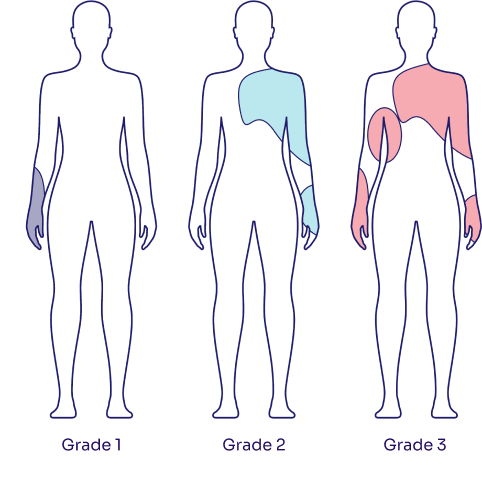
How to grade rash maculopapular:
Grade 1
Macules/papules covering <10% BSA with or without symptoms
Grade 2
Macules/papules covering 10%-30% BSA with or without symptoms; limiting instrumental ADL; rash covering >30% BSA with or without mild symptoms
Grade 3
Macules/papules covering >30% BSA with moderate or severe symptoms; limiting self-care ADL
Distribution of cutaneous adverse reactions on the body will vary by case.
For persistent rash, consider secondary prophylaxis with topical steroids and/or nonsedating oral antihistamines5
*CARs include butterfly rash, dermatitis, allergic dermatitis, dry skin, eczema, erythema multiforme, hand dermatitis, palmar-plantar erythrodysesthesia syndrome, pruritus, rash, erythematous rash, maculopapular rash, papular rash, skin discoloration, skin fissures, skin reaction, skin ulcer, urticaria, purpura, erythema, and drug eruption.1
†In patients with Grade ≥2 cutaneous adverse reaction (n=116).1
‡Occurred in >10%.10
§Rash includes rash macular, rash maculopapular, rash papular, and rash pruritic.4
Management of ARs for TRUQAP + fulvestrant
Learn about adverse reaction management, and understand the importance of identifying and addressing signs early.
KOL Video #2
Downloadable APP & Nurse Resources
The following resources are available for download.
Downloadable Patient Resources
The following resources are available for download.
Helping patients access the care they need

The AstraZeneca Access 360TM program provides personal support to help streamline access and reimbursement for TRUQAP. To learn more about the Access 360 program, please call 1-844-ASK-A360 (1-844-275-2360), Monday through Friday, 8 AM - 6 PM ET, or visit www.MyAccess360.com.
Learn how to enroll your patients in Access 360
aBC=locally advanced breast cancer not amenable to resection or radiation therapy with curative intent; ADL=activities of daily living; AKT1=serine/threonine protein kinase 1; AR=adverse reaction; BMI=body mass index; BSA=body surface area; CDK4/6i=cyclin-dependent kinase 4/6 inhibitor; ET=endocrine therapy; FG=fasting glucose; HbA1C=glycated hemoglobin; HER2−=human epidermal growth factor receptor 2 negative; HR+=hormone receptor positive; LHRH=luteinizing hormone-releasing hormone; mBC=metastatic breast cancer; mPFS=median progression-free survival; PIK3CA=phosphatidylinositol-4,5-bisphosphate 3-kinase catalytic subunit alpha; PTEN=phosphatase and tensin homolog.
References: 1. TRUQAP® (capivasertib) [prescribing information]. Wilmington, DE: AstraZeneca Pharmaceuticals LP; 2026. 2. Sampayo V, Tofthagen C. Hyperglycemia and cancer: an algorithm to guide oncology nurses. Clin J Oncol Nurs. 2017;21(3):345-352. doi:10.1188/17.CJON.345-352 3. Yale Medicine. Hyperglycemia: Symptoms, Causes, and Treatments. Accessed October 9, 2025. https://www.yalemedicine.org/conditions/hyperglycemia-symptoms-causes-treatments 4. Rugo HS, Oliveira M, Howell SJ, et al. Capivasertib and fulvestrant for patients with hormone receptor-positive advanced breast cancer: characterization, time course, and management of frequent adverse events from the phase III CAPItello-291 study. ESMO Open. 2024;9(9):103697. doi: 10.1016/j.esmoop.2024.103697 5. Turner NC, Oliveira M, Howell SJ, et al. Capivasertib in hormone receptor-positive advanced breast cancer. N Engl J Med. 2023;388(22):2058-2070. doi:10.1056/NEJMoa2214131 6. Miller C, Sommavilla R, Murphy D, Morris T, Khatun M, Cullberg M. The effect of food and acid-reducing agents on the pharmacokinetic profile of capivasertib: results from a randomized, crossover study. Br J Clin Pharmacol. 2023;89(11):3330-3339. doi:10.1111/bcp.15831 7. ChemoCare. Diarrhea and Chemotherapy. Accessed October 9, 2025. https://dctd.cancer.gov/research/ctep-trials/for-sites/adverse-events/ctcae-v5-5x7.pdf">https://dctd.cancer.gov/research/ctep-trials/for-sites/adverse-events/ctcae-v5-5x7.pdf 8. Benson AB 3rd, Ajani JA, Catalano RB, et al. Recommended guidelines for the treatment of cancer treatment-induced diarrhea. J Clin Oncol. 2004;22(14):2918-2926. doi:10.1200/JCO.2004.04.132 9. US Department of Health and Human Services. Common Terminology Criteria for Adverse Events (CTCAE) Version 5.0. November 27, 2017. Accessed October 9, 2025. https://ctep.cancer.gov/protocoldevelopment/electronic_applications/docs/CTCAE_v5_Quick_Reference_8.5x11.pdf 10. Data on file. REF-235937. AstraZeneca Pharmaceuticals LP. 11. ChemoCare. Rash and Chemotherapy. Accessed December 12, 2025. https://chemocare.com/sideeffect/rash

IMPORTANT SAFETY INFORMATION ABOUT TRUQAP® (capivasertib) tablets
TRUQAP is contraindicated in patients with severe hypersensitivity to TRUQAP or any of its components.
Hyperglycemia
TRUQAP can cause severe hyperglycemia, including diabetic ketoacidosis and fatal outcomes
Metastatic HR-Positive, HER2-Negative Breast Cancer
PTEN-Deficient Metastatic Androgen Pathway Modulation-Naïve or -Sensitive Prostate Cancer
The safety of TRUQAP has not been established in patients with Type 1 diabetes or Type 2 diabetes that is uncontrolled or requiring insulin at baseline as these patients were excluded from clinical studies. Before initiating treatment with TRUQAP, test fasting glucose levels (FPG or FBG), HbA1C levels, and optimize fasting glucose. After initiating treatment with TRUQAP, monitor or self-monitor FG levels on Day 3 or 4 of the dosing week during weeks 1, 2, 4, 6, and 8; then monthly while on treatment with TRUQAP; and as clinically indicated. Monitor HbA1C levels every 3 months during treatment with TRUQAP and as clinically indicated. Patients with a history of well-controlled Type 2 diabetes mellitus may require intensified anti-hyperglycemic treatment and close monitoring of FG levels.
For patients who experience hyperglycemia during treatment with TRUQAP, monitor FG at least twice weekly, on days on and off TRUQAP, until FG decreases to baseline levels. During treatment with anti-diabetic medications, monitor FG at least once a week for 2 months, followed by once every 2 weeks, or as clinically indicated. Consider consultation with a healthcare practitioner with expertise in the treatment of hyperglycemia and initiation of FG monitoring at home for patients who have risk factors for hyperglycemia or who experience hyperglycemia. Advise patients on the signs and symptoms of hyperglycemia and counsel patients on lifestyle changes.
Withhold TRUQAP immediately when ketoacidosis is suspected. If ketoacidosis is confirmed, permanently discontinue TRUQAP. Withhold TRUQAP in clinical situations known to increase the risk of severe hyperglycemia or ketoacidosis (eg, suspected serious infection or acute illness). Based on the severity of hyperglycemia, withhold, reduce dose, or permanently discontinue TRUQAP.
Diarrhea
TRUQAP can cause severe diarrhea associated with dehydration
Metastatic HR-Positive, HER2-Negative Breast Cancer
PTEN-Deficient Metastatic Androgen Pathway Modulation-Naïve or -Sensitive Prostate Cancer
Monitor patients for signs and symptoms of diarrhea. Advise patients to increase oral fluids and start anti-diarrheal treatment at the first sign of diarrhea while taking TRUQAP. Withhold, reduce dose, or permanently discontinue TRUQAP based on severity.
Cutaneous Adverse Reactions
TRUQAP can cause cutaneous adverse reactions, which can be severe, including erythema multiforme (EM), palmar-plantar erythrodysesthesia (PPE), and drug reaction with eosinophilia and systemic symptoms (DRESS).
Metastatic HR-Positive, HER2-Negative Breast Cancer
PTEN-Deficient Metastatic Androgen Pathway Modulation-Naïve or -Sensitive Prostate Cancer
Monitor patients for signs and symptoms of cutaneous adverse reactions. Early consultation with a dermatologist is recommended. Withhold, reduce dose, or permanently discontinue TRUQAP based on severity.
Embryo-Fetal Toxicity
Based on findings from animals and mechanism of action, TRUQAP can cause fetal harm when administered to a pregnant woman. Advise pregnant women and females of reproductive potential of the potential risk to a fetus. Advise females of reproductive potential to use effective contraception during treatment with TRUQAP and for
1 month after the last dose.
Advise male patients with female partners of reproductive potential to use effective contraception during treatment with TRUQAP and for 4 months after the last dose.
TRUQAP is used in combination with fulvestrant or abiraterone. Refer to the full Prescribing Information of fulvestrant or abiraterone for pregnancy and contraception information.
ADVERSE REACTIONS
Metastatic HR-Positive, HER2-Negative Breast Cancer
PTEN-Deficient Metastatic Androgen Pathway Modulation-Naïve or -Sensitive Prostate Cancer
DRUG INTERACTIONS
Strong CYP3A Inhibitors: Avoid concomitant use with a strong CYP3A inhibitor. If concomitant use cannot be avoided, reduce the dose of TRUQAP and monitor patients for adverse reactions.
Moderate CYP3A Inhibitors: When concomitantly used with a moderate CYP3A inhibitor, reduce the dose of TRUQAP and monitor patients for adverse reactions.
Strong or Moderate CYP3A Inducers: Avoid concomitant use of TRUQAP with strong or moderate CYP3A inducers.
INDICATIONS AND USAGE
Please see full Prescribing Information, including Patient Information for TRUQAP.
You may report side effects related
to AstraZeneca products .
.
INDICATIONS AND USAGE
IMPORTANT SAFETY INFORMATION ABOUT TRUQAP™ (capivasertib) tablets
Expand